

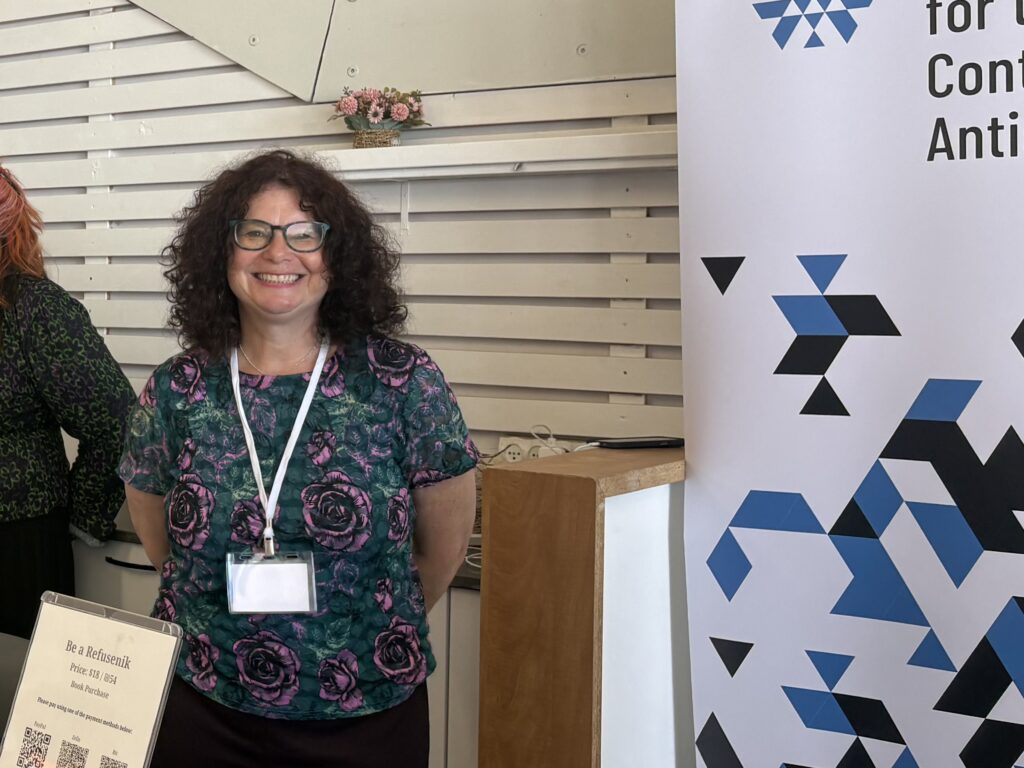
Dany Louise gives a snapshot of the Haifa Conference and the launch of the new CASA network
Day 1
You fight the traffic in Israel. Wherever you are, the traffic is horrendous. You fight the traffic in the port city of Haifa. You monitor the road, not the surroundings. But eventually you get to where you are going and for us, in Haifa, it is the university campus. We are marched through and down to the right building, and then stop and gaze in awe at the view. Built on the spine of Mount Carmel, it is breathtaking – and not a road or car in sight. The relief of calm rarefied air and academic endeavour envelopes the delegates. Here we are, academics, scholars and others gathered from around the world for three days, many from hostile home campuses, helping to establish and forward a new field of contemporary antisemitism studies.

As a layperson, the conference structure reminds me of the Limmud model: seven or eight sessions of 90 minutes taking place simultaneously, with plenty of networking breaks, drinks and snacks. Only the organisers have the overview and delegates must choose which topic or track interests them most at any given time. It is an opportunity to share research, to network, to launch new initiatives, to support each other, and to unapologetically centre the Jewish perspective. No-one has to explain that Jewish context to anyone; we all understand far too well the worldwide 21st century spike in Jew-hate. This year, in 2026, we are very deliberately in Israel. Postponed from March, 350 odd delegates have made the journey to be here, because Israel is Israel. To rather crudely state the bottom line, it is either our literal home or our emotional, psychological and potential home of last resort. Whichever way it is a connection we honour with respect and love.
Professor David Hirsh, our CEO and Academic Director, has traced the rise in contemporary antisemitism for decades. For him, the World Conference against Racism in Durban in 2021 was a key staging post. This event has become infamous as a supposedly anti-racist conference that was over-run with antisemitic anti-Israel prejudice overtly presented as an underlying culture of “right think” by progressive “communities of the good”. Nothing that has followed has really surprised him – he has documented and written a book on the trajectory of how this culture based on spurious and bastardised Soviet propaganda dressed up as academic theory has migrated from the crank fringes to the mainstream in the following two decades.
In a session about addressing antisemitism on campus, Kent Harber from Rutgers University said “I wasn’t previously aware that I was a Jewish academic, my subject is psychology” – but as with Jewish academics worldwide, he has necessarily been co-opted into the fight. There seems to be consensus that formal Networks are a useful mechanism. Some already exist, and some have been born or revamped out of necessity in recent years. Harber is instrumental in the success of the US based Academic Engagement Network (AEN) supporting academics to address antisemitism on campus, and which now has 25,000 members. The AEN undertakes a range of activities, not least of which is training, as well as giving microgrants to enable challenging initiatives to go ahead. With such a large membership it genuinely intervenes successfully in a range of areas, including with the somewhat “extremely toxic reputation of DEI across the Jewish academic world” as Ayal Feinberg of Gratz College puts it. “While the people who run programmes may be sincere, they simply don’t have the training to understand contemporary antisemitism or know how to address it”.
Another perspective came from an academic I spoke to from Brandeis University who thinks that after the crushing lowpoints of multiple externally organised encampments and vicious actions in 2024, the situation has improved. She says the reasons for this are varied; yes, a new political administration that has made it clear that universities will face financial penalties if they continue to allow the overt bullying of Jews on campus. Second, half the students who took part in the encampments have graduated and left. They are now out in the world, presumably to be tamed by reality or further radicalised. And finally, the universities themselves have often changed the student Code of Conduct to outlaw the types of actions that were so endemic. Her current research across Brandeis suggests that the perception from minority students across categories is that they all feel equally marginalised.
Are we past the worst? Can the demonic genie be put back in the bottle? Barely anyone thinks so. There are constantly new dogwhistles and new semantic formulations being twisted into service, particularly online. Liram Koblentz-Stenzler from the International Institute of Counter Terrorism explains the process of how the phrase “spiritually Israeli” is a new example of this. It’s a made up term that is semantically drifting and developing to a place where it can encompass ridiculous notions of ideological purity and taint or delegitimise anyone – Jewish, Israeli or otherwise – who speaks out against the prevailing culture of Israel as the source of all the world’s evils.
Inevitably, existing and refreshed Networks – however successful – are necessarily reactively pro-active; the problems already exist and have taken on a life of their own. This is where our own new network comes in, the Contemporary Antisemitism Studies Association, or CASA for short. Launched at the conference today to a packed audience, the founding directors are our own Professor David Hirsh, Ayal Feinberg of Gratz College in the US, and David Barak-Gorodetsky, director of the Comper Centre at Haifa University. They are very clear about its aims: “We are building a home and infrastructure of the new discipline of Antisemitism Studies” declared Hirsh at the launch. “We will be a home for the academically homeless, and provide the infrastructure and foundations for the discipline to grow in the years ahead”.
To do that, the founders have identified five key practise areas that CASA will develop to turn their ideals into reality:
- An international membership of academics and scholars, with 150 founding members already.
- Conferences and opportunities to convene, with the next international conference taking place in Philadelphia in 2027.
- Publishing and in particular a new peer-reviewed Journal which will be open access and provide an eight-week turnaround for authors. A robust, impressive and importantly numerous editorial board has already been assembled. It will open for its first submissions on 1st September.
- Active and formal mentoring of young and new scholars, providing the support and back up they need to find their way in what is, at its worst, a pretty dog eat dog academic world, even without antisemitism.
- Turning theory into active practice through a range of mechanisms to produce knowledge and research which will educate and influence in both targeted and generalised ways.
CASA is interesting and exciting. It is no accident that its three founding “stewards” run smallish institutions with minimal bureaucracy. This enables each to be powerful on their own terms, to observe, analyse, and propose solutions. They can take decisions on policy and practice, and get on with implementing initiatives speedily and with the resources of their respective organisations – a situation many institutional directors can only dream of.
“We have a dream of many sub-networks,” says Hirsh. “We are already working on antisemitism and sport, and Islamic antisemitism. But we are counting on our membership to actively participate – if you want a sub-network, then create it!”
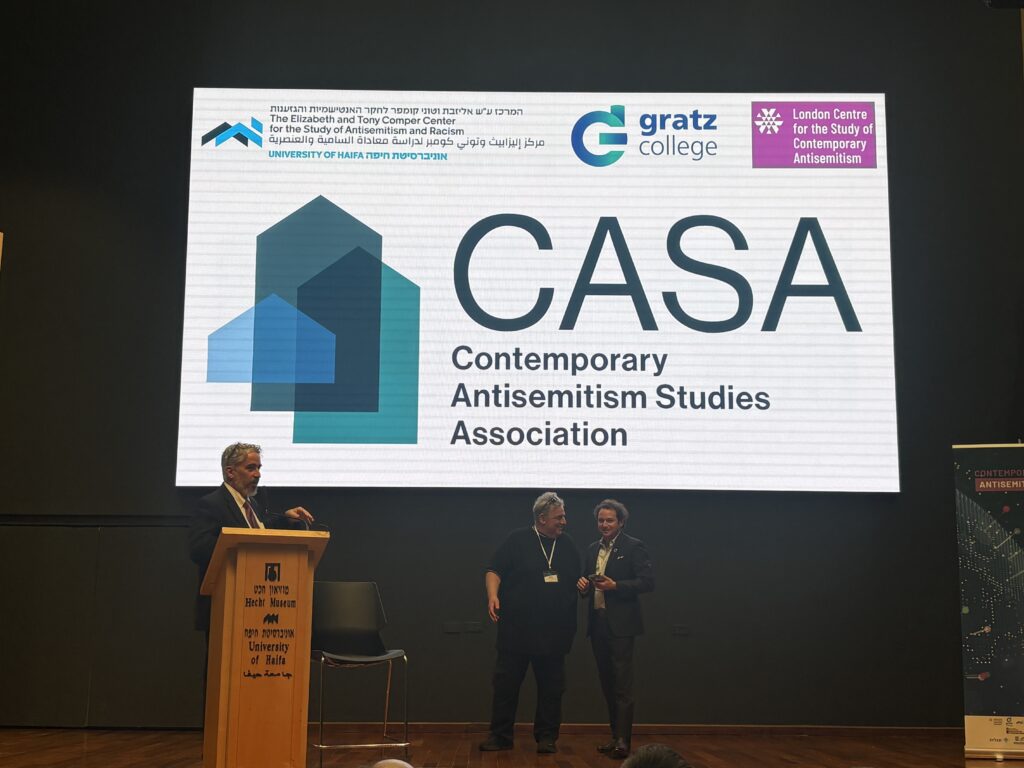
We have gone public with CASA now: www.contemporaryantisemitism.com It will become increasingly populated so keep an eye on our website and social media for our latest news and progress. Or sign up to our newsletter here: www.londonantisemitism.com
Day 2
We wake to news that Iran has bombed US positions in the gulf overnight, and that there have been 80 retaliatory strikes by America. We raise eyebrows at each other over breakfast and check that flights are still operating to and from Israel. Then we get on with our day. But there is a slightly ragged air at conference this morning. We all had rather a late night yesterday, what with the university gala event in the magnificent Hecht Museum auditorium. It was followed by – so I have heard – lengthy extra-curricular activities by some of the more hardcore delegates.
At the gala, the president of Haifa University, Professor Gur Alroey defined the university archetype as research followed by dissemination to a beyond-university audience. The days of the ivory tower are over – research must have practical real world application and appropriate influence. Policy makers, educators, students, civic infrastructure all need to benefit for the university to fulfill its role within society. No-one argued with him.
There followed astonishing speaker after astonishing speaker. Professor Irwin Cotler was introduced – he is a former Minister of Justice and Attorney General of Canada, and international Chair of the Raoul Wallenberg Center for Human Rights. He spoke from decades of experience, where he seems to have met everyone who was anyone, demonstrating his view that there cannot be human rights where antisemitism exists. Professor Dina Porat charmingly accepted a Lifetime Achievement Award. As Chief Historian of Yad Vashem and Professor Emeritus of Jewish History at Tel Aviv university she is greatly and deservedly esteemed. The keynote was given by the charismatic powerhouse that is Professor Deborah Lipstadt, who characteristically intertwined the worrying institutionalisation of antisemitism with the positivity and joy of being Jewish: “I am at the joy end of oy!” Having served as President Biden’s “antisemitism ambassador”, like Cotler she has an experiential world-wide overview of the fight against antisemitism. Her perspective is unique, and after a lifetime of teaching, she is a world class communicator. It was a privilege to be in the audience, and a night I will remember for a long time.
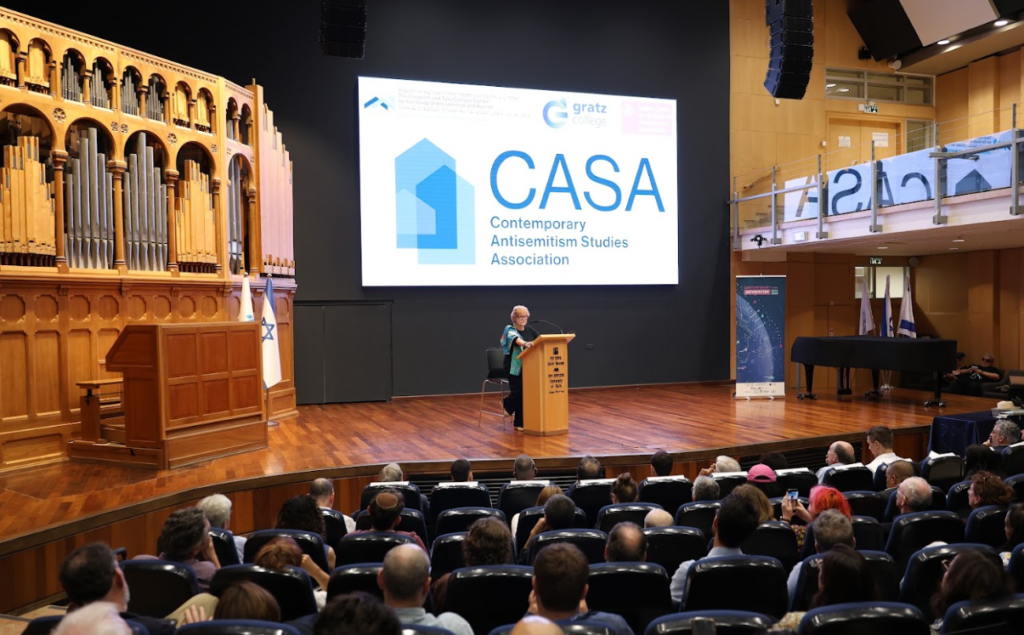
So day 2 has been more relaxed. There are lots of informal conversations taking place alongside the formal conference programme. Delegates are enjoying spending time on the terraces in the balmy sunshine, drinking in the view and excellent coffee. I start the day listening to a panel which convincingly argued, multiple times over, that contemporary antizionism is indeed a code that functions as a vicious reiteration of all the old antisemitic tropes (Jews are land grabbing genocidal baby killers yada yada yada). Further, it persuasively demonstrated that without a doubt, it is part of the feedback loop that leads to confrontation, discrimination and ultimately violence against Jews worldwide. As such, it is not a respectable ‘identity’ to use in polite company, despite antizionist “asa jews” trying to suggest otherwise (although a UK court has come close to designating it “a protected characteristic”). This much, of course, we all knew, but the value was to have the arguments spelt out in clear language, with the invitation to deploy them in our own specific individual battles against antisemitism. Having been reminded of our enemies’ dispiriting use of lawfare against Jews, it was heartening to listen to the presentation by Professor Rona Kaufman of the Centre for Jewish Law and Policy. She pointed out that the law has been significantly developed since the sixties to protect other minorities or identities (a long list but including people with disabilities, sexual harrassment and discrimination etc) but that no such body of case law exists for Jews. This is her area of specialism, and this is the work of the Centre which she co-founded. How heartening to know that this problem has been observed, analysed and solutions are being worked on! Such understanding again demonstrates the value of convening, of conferences – where else can you gain such knowledge, and other specialised knowledge from outside your own narrow specialisms?
Today’s keynote was delivered by Professor Karin Stogner, entitled Critical Theory, 7 October and the Critique of Antisemitism and Sexism. It was dense and complex and beyond me to attempt a summary – but I will also note she gave the Keynote Lecture at our 2024 Robert Fine Memorial Lecture (our own annual showcase event).
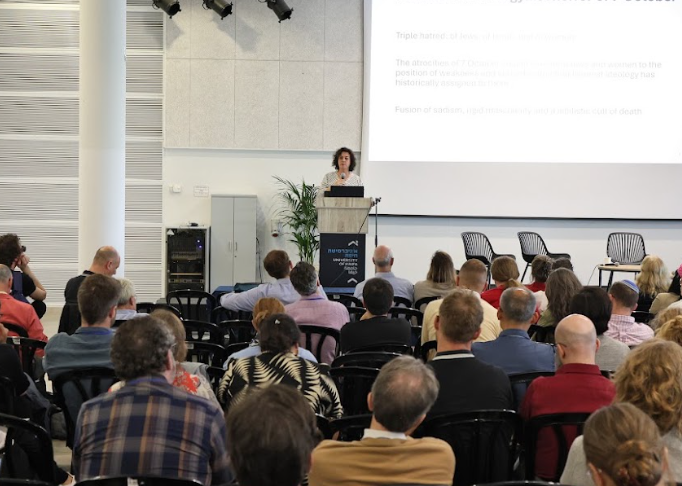
Immediately after I opened twitter (it’s still twitter to me) to make a post. And there was @HillelNeuer, who does Very Important Work at UN Watch and who is a very busy man: “Today, at Haifa University’s @compercentre, hundreds of scholars have gathered for the largest annual academic conference on contemporary antisemitism.” So we have, and so we are. Thank you for the recognition, Mr Neuer!
Day 3
The day is split into four tracks – Education, Law, AI, Quantitative – before we all came together for the end of conference plenary and keynote. In Law, I learned more about how and why Bristol University failed so dismally when they sacked one of their professors after student complaints of antisemitism, and the professor took them to an employment tribunal. As Jonathan Karris KC pointed out “courts rule on very narrow aspects of law”. In this case, Bristol Uni’s original investigation into the complaints was carried out by a lawyer who had previously had a commercial relationship with the professor. The findings of that investigation – that Miller was not antisemitic in the university environment – constrained the university’s defence in the tribunal.
It was also interesting to hear about what powers nation state law has to tackle rampant online antisemitism. It seems there are some actions that can be taken, but the scale is such that it can only realistically be addressed at the platform level. All the four major social media platforms have policies and procedures in place, some considerably more robust than others. Tiktok
comes top in this regard, in terms of the strength of those procedures, and crucially, in terms of enforcing them, and to no-one’s surprise, Twitter/X comes bottom by a long way.
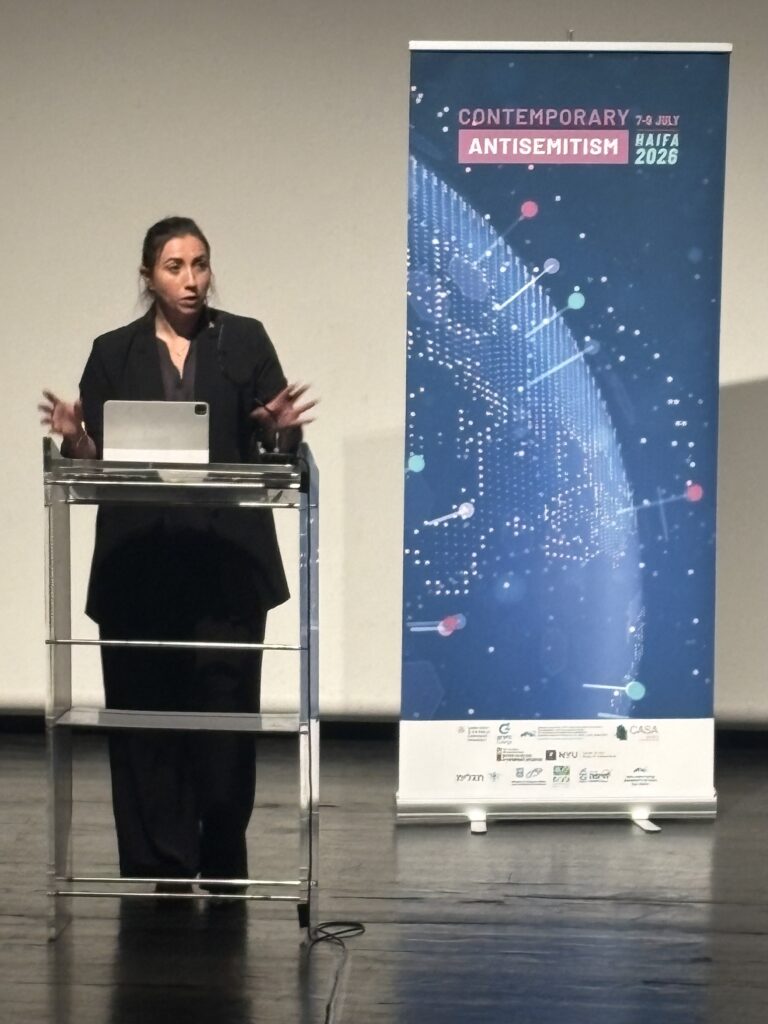
But the climax was the end of conference plenary and keynote. The extraordinary Dr Cochav Elkayam-Levy talked about the enormously important “Silenced No More” report which she helped author, and which has been produced from Israel’s Civil Commission on October 7th: Crimes by Hamas Against Women and Children. It is subtitled Sexual Terror Unveiled: The untold Atrocities of October 7th and against Hostages in Captivity. It is a horrifying report, weighty in every sense of the word. The Commission has collected the testimony and documentary evidence of survivors and published it all in one place. There can be no arguing with it, no denying of these horrific facts, no minimisation. It has had impact around the world, and was unignorable by the world’s press – despite the obfuscation initiated by Hamas the day before its release that involved highly trained dogs doing impossible things to Palestinian prisoners, which the world’s press uncritically and even gleefully repeated. The Commission is lead by Dr Elkayam-Levy and its archives serve as both a memorial and a vital historical and legal record. Its Board includes prominent figures like Sheryl Sandberg and Professor Irwin Cotler, and it continues to raise awareness and fight for justice for the victims of October 7th. To support this work, visit: www.civilc.org/donate
And then we really did reach the final event, a passionate discursive lecture from the renowned philosopher Bernard-Henri Levy, whose latest book “Israel Alone” is now published in Hebrew.
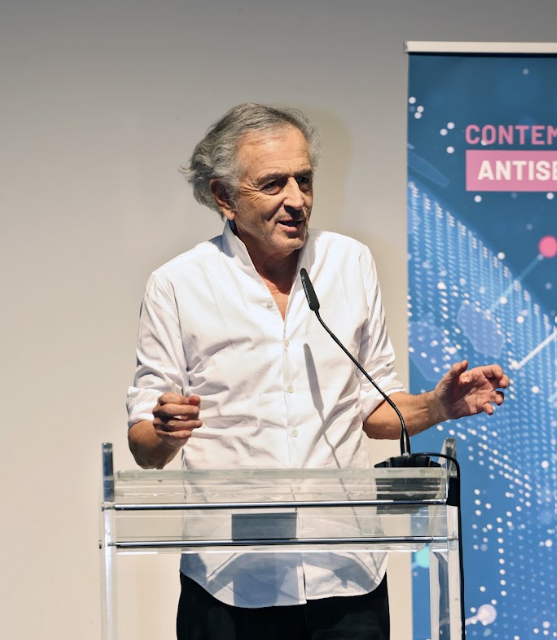
Fifty years ago he predicted this world-wide wave of antisemitism linked to Israel. “Antizionism was the only way for antisemitism to revitalise itself. It needs antizionism to draw people to it, to bring in new adherents.” Looking at the last fifty years through this lens, the debate about whether antizionism is antisemitism is irrelevant. “Antizionism means that Jews all over the world are complicit with the evil state, therefore you can target all Jews. So antizionism’s reach becomes antisemitism. This is exactly what is happening today, all over the world.” Thus is demolished the ever popular ‘it’s only criticism of Israel’ defence. He describes the current mass demonisation of Israel as a “distortion of the mind”, as a willful refusal to acknowledge reality. “The will not to know, not to see, was a worldwide decision.” It used to be there were two countries in which Jews could be safe – Israel and the US. Now even the US is gone although Levy insists that “the real America can defeat this phenomenon. Who are our allies?” he ponders, and his answer lies in political philosophy rather than nation states: “Those who believe in liberal democratic values, those who believe that society can be diverse.” This worldwide failure to do right, this sense that over the last fifty years the West has been not only in moral decline, but in a debilitating crisis of political courage as well, doesn’t only affect Jews. It has been evident in Europe’s failure to support Ukraine in their war against Russian aggression, a failure to see it as a critical crisis for all of Europe, not simply a localised conflict where it is sufficient to bung a bit of arms money to the victim state. Levy sees this not only as a disgrace, but a geopolitical failure revealing the extent of the West’s decline. It is hard to argue with his conclusions. Charismatically delivered, Levy nonetheless articulated a bleak picture, describing a historical moment and trajectory from which there is little cause for optimism.
Dany Louise is LCSCA’s freelance Events Manager


