

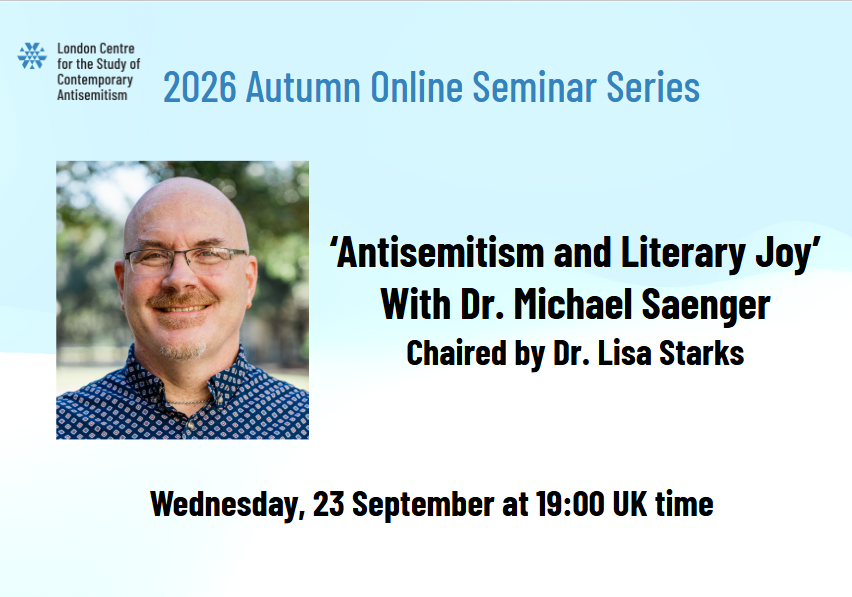
At a time of war and hate, it would seem that the topic of literary joy would be at best irrelevant, and at worst offensive even to contemplate. But such a rejection would reduce humanity to brutal binaries of utility and feeling, and nothing could be further from the truth. Our ability to do good things is inescapably bound to our ability to appreciate poetry, and if Shakespeare could be credited with anything, it would be a sensitivity to what we feel. In this talk, Dr Saenger will begin by raising a familiar issue: how do we enjoy art when the views of the artist trouble us? The litany of such artists is well known: with respect to Jews and antisemitism, we could debate the merits of Chaucer, Wagner, Hemingway, Woolf, Eliot, Bardem. Should we stand in judgement over them, and over Shakespeare?
It is tempting to revisit these debates, weighing individual intent with a judicious caution about various moments in culture, and various epistemic histories. Such judgement is not the topic of this talk. Instead, he will look into the poetics of feeling in the Merchant of Venice, with particular focus on the question of Jewish joy, and Jewish sadness. In so doing, he hopes to provide a window through which we can enjoy the beauty of the past while we struggle against the ugliness of the present.
To introduce Dr. Michael Saenger’s talk, Dr Lisa Starks will be speaking briefly on “Shakespeare and Jewish Joy,” focusing on how Shakespearean adaptations created by and primarily for Jewish communities past and present not only have grappled with trauma and antisemitism but also have celebrated Jewish joy.


